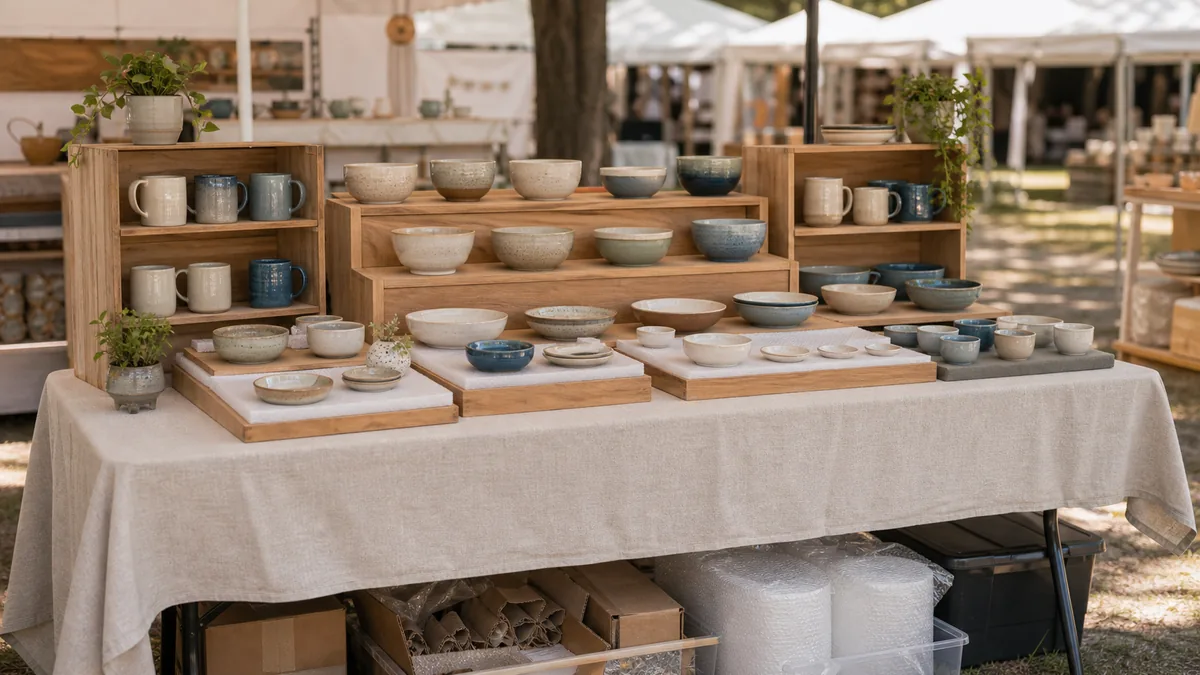
Ceramics can make a strong booth visually, but they bring three constraints: weight, breakage and customer handling. A pretty table is not enough. You need to think about transport, support, space between pieces and packaging after the sale.
Quick answer
For a ceramic booth, transport pieces in rigid padded crates, display less stock than you bring, create low stable levels, leave enough room for customers to pick up one piece without touching three others, keep fragile pieces away from the edge and prepare packaging before opening.
In this guide
- Quick answer
- Plan transport before display
- Display less to sell better
- Use low and solid levels
- Organize customer handling
- Prepare packaging before sales
- Common mistakes
- Final checklist
- Useful gear to compare
- FAQ
- How many ceramic pieces should I display?
- How do I prevent breakage when customers handle pieces?
- What should I use for displaying plates?
- What packaging should I prepare for sold ceramics?
- Read next
Plan transport before display
If transport breaks pieces or exhausts you, the booth is fragile before it even opens.
- Rigid crates in manageable sizes
- Padding between every piece
- Weight limited per crate
- Heavy pieces on the bottom
- Photo of packed layout so you can repeat it
Display less to sell better
A table full of ceramics can look impressive, but it can also make customers afraid to touch and increase fall risk.
- Clear selection by use or collection
- Space between pieces
- One sample for fragile variants
- Reserve stock padded under table
- Restock during quiet moments
Use low and solid levels
Height helps readability, but supports must handle weight and table bumps.
- Wide risers
- Non-slip mat under supports
- Plate stands suited to the item
- Tall pieces away from edge
- No unstable stacking
Organize customer handling
Customers want to feel weight and texture. Let them do it without putting the full booth at risk.
- Clear pickup zone
- Fragile pieces close to you
- Simple phrase offering help
- No stack too high
- Free surface to set down a piece
Prepare packaging before sales
The sale does not end at checkout. Slow or weak packaging can break the piece after the booth.
- Protective paper ready
- Strong bags
- Cardboard or padding for heavy pieces
- Separate packing zone
- Carry advice for customer when needed
Common mistakes
These mistakes come from designing the table like a photo, not like a handling area.
- Crowding pieces together
- Stacking bowls too high
- Using decorative supports that are too light
- Forgetting pack-down weight
- Packing sold pieces without enough space
Final checklist
Test the table by picking up one piece like a clumsy customer would.
- Each piece can be picked up without touching three others
- Supports do not slide
- Higher-value pieces are close to me
- Packaging is ready
- Under-table stock is padded
- Crates are still carryable when full
Useful gear to compare
These links help compare useful gear categories. Check dimensions, weight, stability and packed size first.
| Need | Useful search | Check |
|---|---|---|
| Fragile transport | look for storage boxes for pottery transport | Rigidity, loaded weight, lid and dimensions. |
| Padding | compare foam sheets for ceramic packing | Thickness, size, reuse and protection. |
| Piece protection | look for bubble wrap for ceramic transport | Width, cutting, volume and reuse. |
| Stable table | search for non slip mat for pottery display | Grip, thickness, cleaning and cutting. |
| Plates and flat pieces | compare plate display stands for craft fairs | Angle, base, weight support and transport. |
FAQ
How many ceramic pieces should I display?
Less than total stock. Show a readable selection with space between pieces, then keep padded restock under the table.
How do I prevent breakage when customers handle pieces?
Leave a pickup zone, keep fragile items close, avoid tall stacks and offer help for heavy or higher-value pieces.
What should I use for displaying plates?
Use a low, stable stand suited to the weight. Test it with the real plate on the same table and cover you will use at the event.
What packaging should I prepare for sold ceramics?
Protective paper, strong bags, padding for heavy pieces and a free packing area where you do not push the rest of the table.