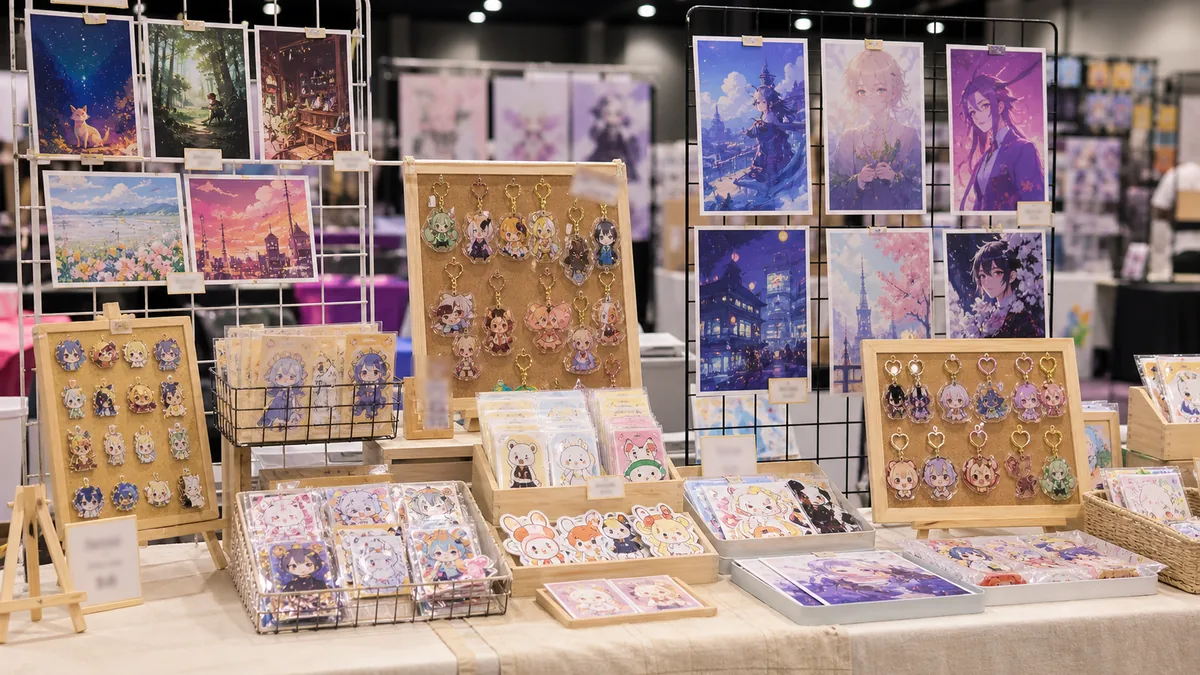
Large prints attract from far away, but they take over the table quickly. If everything lies flat, visitors do not see the artwork. If you hang too much too high or too fragile, you risk bent corners, wind, falls and a setup that takes too long.
Quick answer
To display large prints, show a few strong designs at height, keep variants in a browsing bin or portfolio, protect each print in a sleeve or rigid backing, show sizes and prices clearly, and plan flat transport. The wall should attract attention, not replace the whole table.
In this guide
- Quick answer
- Choose which designs go high
- Keep the catalog browsable
- Protect corners and surfaces
- Attach without damage
- Adapt to wind and narrow aisles
- Common mistakes
- Final checklist
- Useful gear to compare
- FAQ
- Should I display every large print?
- How do I prevent bent corners?
- What is the best Artist Alley print display?
- How do I handle large prints outdoors?
- Read next
Choose which designs go high
The upper display should explain your visual world from the aisle. It should not carry your entire catalog.
- Three to six strong designs
- Sizes visible from the aisle
- No overpacked wall
- Price or size near the visual
- Best sellers at eye level
Keep the catalog browsable
Variants, smaller sizes and older collections can live in a bin or portfolio. Customers can browse without taking the booth apart.
- Stable browsing bin
- Portfolio by size
- Dividers or tabs
- Sample print for each design if stock is limited
- Sale stock separated from browsing sample
Protect corners and surfaces
Prints are harder to sell when corners are already marked. Protection starts before the event.
- Sleeves suited to the print size
- Rigid board for transport
- Clean hands for handling
- No prints under drinks or food
- Checkout surface separate from print browsing
Attach without damage
Every hanging method should be tested with the real paper. Some clips mark, some tape tears, some grids move.
- Clips with moderate pressure
- Corner protection if needed
- Stable grid or fabric backdrop
- Backup ties or clips
- Home test for setup and pack-down
Adapt to wind and narrow aisles
A large print acts like a sail. Outdoors or in tight aisles, stability matters more than height.
- No unweighted large panel outdoors
- Heavy low browsing bin
- Grid attached within event rules
- Displayed prints inside booth footprint
- Table plan if wall display is not allowed
Common mistakes
These mistakes make a print booth slow to set up and easy to damage.
- Putting the whole catalog on the wall
- Leaving bare prints in a deep bin
- Not showing sizes
- Rolling large prints too tightly for transport
- Putting checkout on top of prints
Final checklist
Before opening, check that customers can understand, browse and buy without handling sale stock randomly.
- Strong designs at height
- Catalog browsable
- Prices and sizes readable
- Sleeves clean
- Stock separated from samples
- Return transport protected
Useful gear to compare
These links help compare useful gear categories. Check dimensions, weight, stability and packed size first.
| Need | Useful search | Check |
|---|---|---|
| Table browsing | look for art print display bins for craft fairs | Size, stability, depth and customer access. |
| Protected catalog | compare A3 portfolios for art prints | Size, sleeves, rigidity and weight. |
| Hanging prints | search for poster clips for Artist Alley | Pressure, paper marks, size and attachment. |
| Sale protection | look for clear sleeves for 11×17 art prints | Clarity, thickness, size and closure. |
| Lightweight wall | compare gridwall panels for art prints | Dimensions, stability, weight and event rules. |
FAQ
Should I display every large print?
No. Display the designs that explain your style fastest, then keep the rest in a bin or portfolio. Too many high visuals become unreadable.
How do I prevent bent corners?
Use sleeves, rigid backing and bins that are not too deep. Avoid letting customers browse sale stock without a separate sample.
What is the best Artist Alley print display?
Often a small wall or grid for strong visuals plus a portfolio or bin for browsing. The best setup is the one you can build quickly and transport without damage.
How do I handle large prints outdoors?
Lower the display if wind is present, weight supports, keep prints inside the booth footprint and have a table-only plan if hanging is not allowed.